
Darina Komorowski
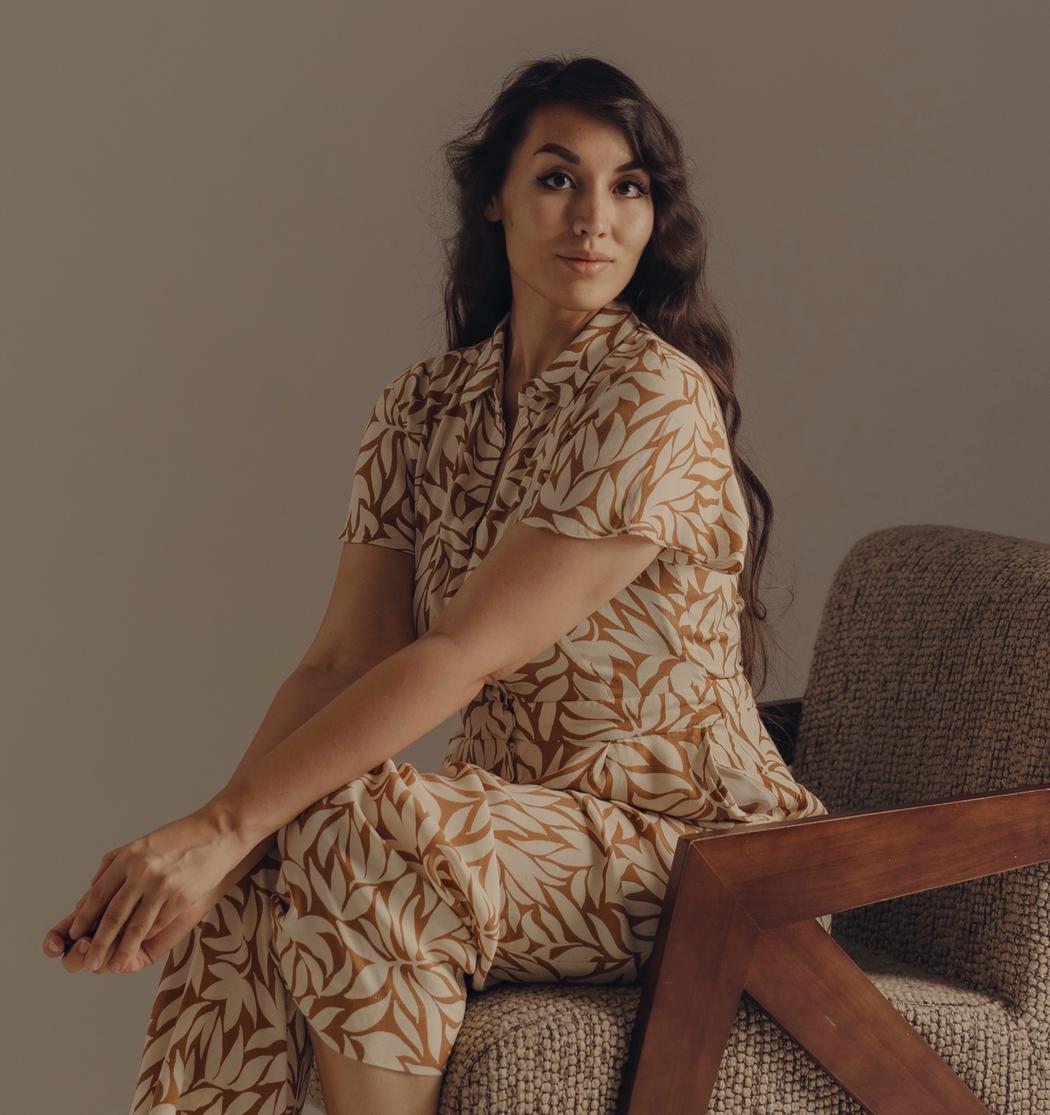
Your practice combines visual art and psychology. How does your psychological background influence the way you construct meaning and emotion in your paintings?
Knowledge of how the human psyche works inevitably changes the way you perceive the world, just as any lived experience does. I’m grateful that, through my training in psychology, I encountered a great deal of unguarded human feeling: vulnerability, tenderness and the quiet beauty of what unfolds inside each of us. I look for the same in painting. I want art to help a person turn inward, because the way we see reality says, first of all, something about us. I wish we would face ourselves more often, finding the courage and the respect to hold our thoughts with warmth.
It matters to me that my paintings don’t pull someone away from life or demand attention by force. But when a viewer has the time and an inner willingness to meet the work, I want it to be able to unpack something, to stir emotion, invite close looking and draw a person in. My canvases are dense with detail and an internal compositional momentum. As you spend time with them, you can move deeper, loosening the knots of your own awareness, thinking, feeling and asking yourself: What are these emotions? What memories or experiences do they touch? How much of this is about me? What is happening inside me right now? What can I take from this encounter and what else have I learned about myself?
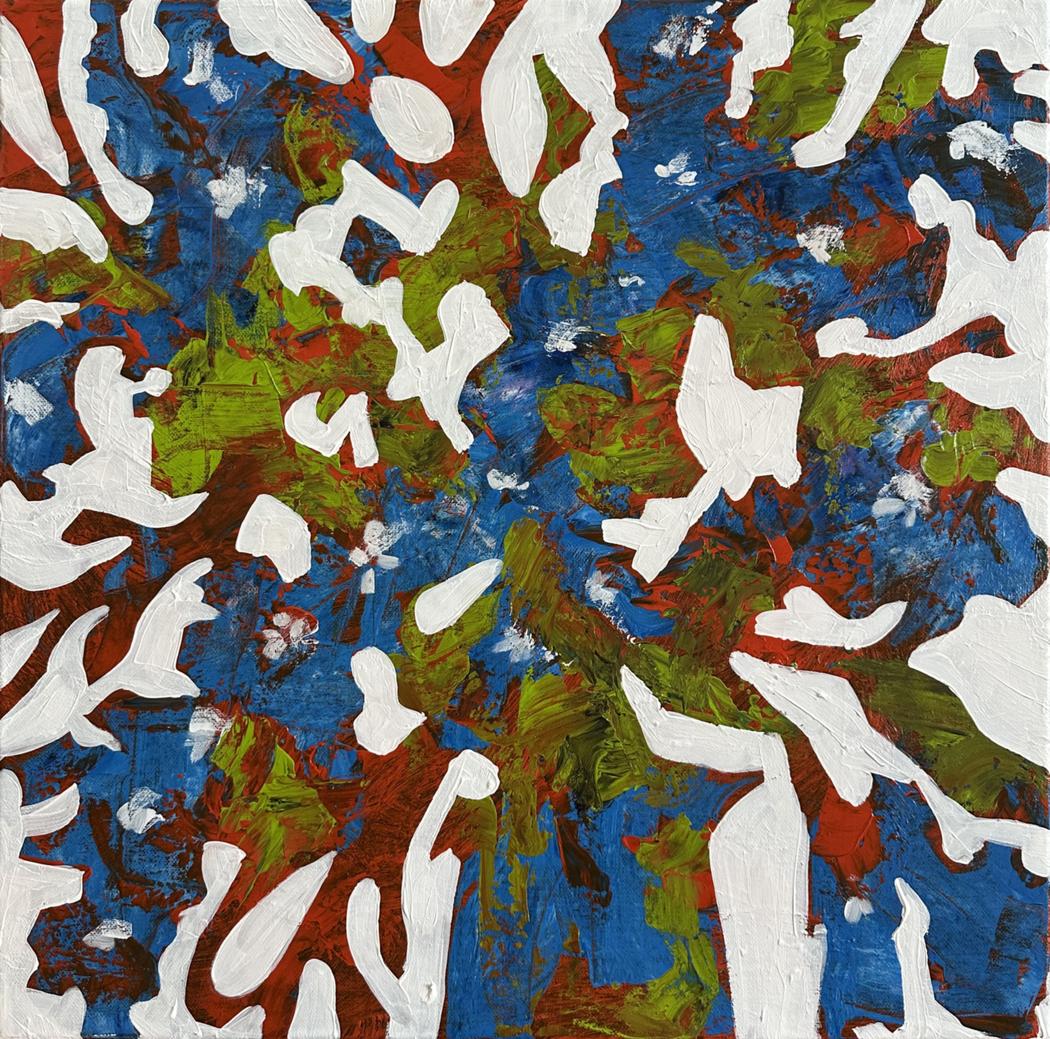 Darina Komorowski | Midday Flowers | 2026
You often describe your visual language as “intensified” and “turned up.” What does exaggeration allow you to express that subtlety cannot?
Many of my paintings are bright and high-contrast because they mirror how a person experiences their own life. For us, the value of each emotion we live through is always high. What happens inside almost inevitably feels stronger, larger, more intense than it appears objectively. That intensity is part of the power and the beauty of being human.
In painting, heightened colour and contrast paradoxically allow you to look at your feelings from the outside, as if carrying them out into the open and seeing them differently. In that shift, you begin to notice that not every emotion or state has to be interpreted exactly the way we’ve learned to interpret it internally.
For me, it’s important to validate emotion, to allow yourself to experience feelings vividly, fully and honestly. At the same time, I want to stay aware of the line beyond which emotion starts to work against life: tightening, limiting, taking away movement and joy. What matters to me is that an experience doesn’t consume a person’s life, but brings them back to it.
Flowers dominate most of your work. When did they become your central motif and what do they allow you to say about human relationships?
Flowers, to me, reflect with great precision what is most alive and most essential in a person. A flower embodies life and naturalness, something basic that exists in each of us. And yet it is vulnerable: it has no will in the human sense, no complex psychological mechanisms, no defences. There is only an impulse toward life, toward light, warmth, growth and happiness.
It is within this contrast that my conversation about human relationships begins. What is most important and most tender in us is, in its essence, deeply “floral”: the desire for love, acceptance and closeness, the impulse to grow, the ability to live through bloom and to respect our own fading. At the same time, in humans these simple impulses are often distorted and amplified. The desire for more, psychological defences, greed, anger, envy. I don’t label these as bad. In many ways they serve a protective function: they hide a person’s vulnerability from themselves, because touching it can be unbearably painful.
I feel that through the image of flowers it becomes possible to speak about relationships gently, humanely and in a life-affirming way. To remind a person that they are alive and that they are part of a larger cycle of life.
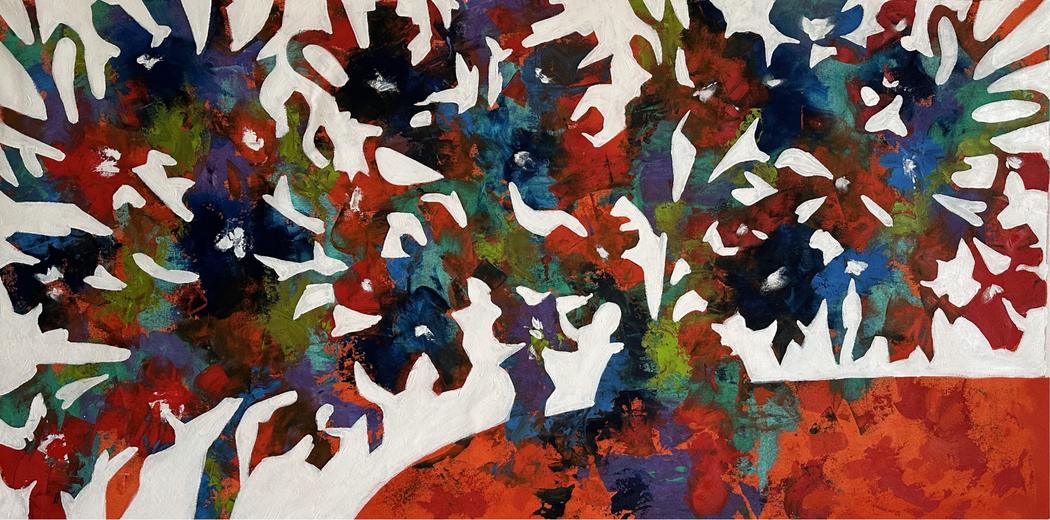 Darina Komorowski | History | 2026
In your series Metamorphosis (2025), transformation plays a key role. What kind of change are these flowers undergoing, emotional, temporal or existential?
I don’t think transformation is ever only one thing. It is emotional, temporal and existential at the same time, because experience cannot be rewound and today we are no longer who we were yesterday. In
Metamorphosis, I wanted to hold onto the sensation of flowing time, when a moment seems to ask: stop, look, you are beautiful, even as your form is still changing.
In this series the flowers undergo metamorphosis before your eyes, as if impressed by emotion, lit from within. There is an elusive beauty to the process that doesn’t require an ideal peak of bloom and there is tenderness toward what gradually fades, shifting its tone and rhythm. I see it as an honest portrait of life, where value doesn’t arrive afterwards, but is born within the current itself.
Existentially, the series moves through acceptance of a changing form and making peace with it. When you allow yourself to see change as natural, the way you look at yourself and the world also shifts. For me, Metamorphosis is about that adjustment of perception and about the ability to remain present, feeling and quietly at ease within the process, noticing life as it unfolds right now.
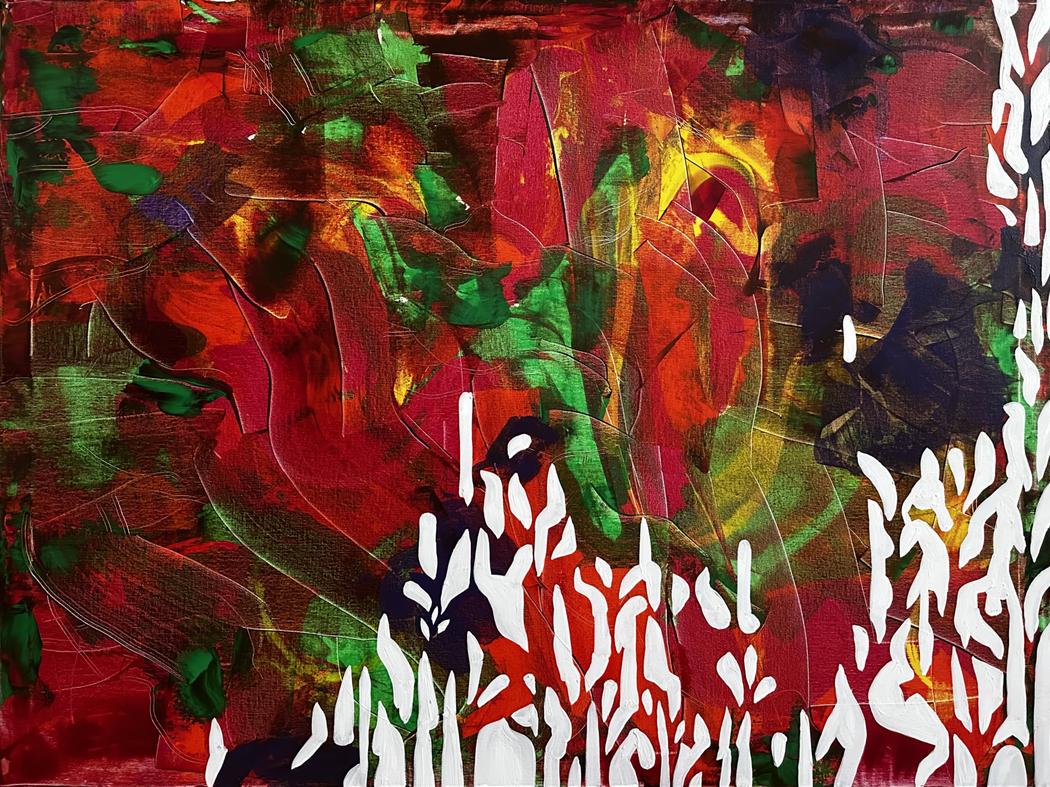 Darina Komorowski | Thoughts | 2026
You speak about the contrast between outward beauty and inner tension. How do you translate something unspoken or invisible into colour and form?
For me, translating what is unspoken into colour and form begins with attention to my own sensations and with the experience of meeting human emotions as they appear without defences. Listening for that, I’m not trying to depict a specific feeling. I’d rather leave the viewer room to live through their own response, because it will always be personal.
In my work, colour often carries tension, remaining bright and direct, like inner experience at its most intense. The composition, by contrast, can be calm and contained, holding balance, offering a structure against which colour becomes sharper and more audible. That’s how a sense of external clarity can emerge while something living continues to pulse underneath.
I often think of tension as a signal you can notice without suppressing it or rushing past it. Working with form and rhythm, I try to create a space where a viewer, lingering with their gaze, meets their own states and leaves the encounter a little more sensitive and present.
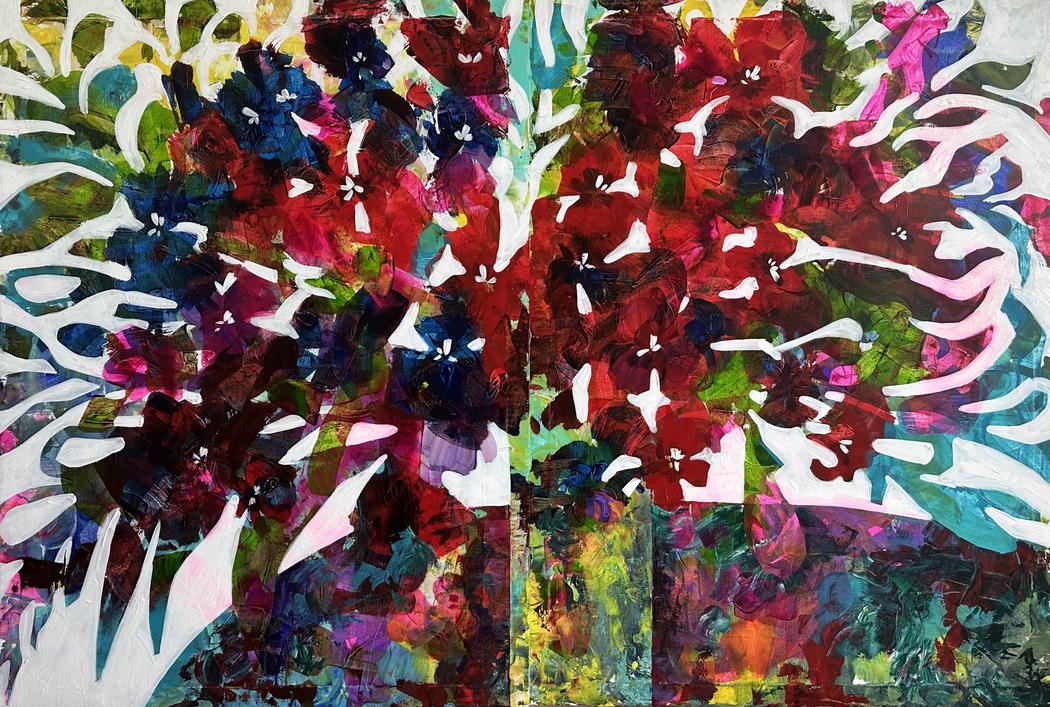 Darina Komorowski | The Presence Of Life | 2025
Your paintings often feel suspended in time, as if caught at the peak of bloom. Why is this moment before fading so important to you?
Not all of my paintings are fixed at a peak. My most recent series is largely devoted to transition and metamorphosis, the changes a person moves through. These works are about movement and about respect for the process of transformation, in which life shifts its rhythm, its tonality, its form, without losing its value.
In earlier works, I was drawn to a sense of time pausing, when the gaze slows down and you can feel what usually slips past. That kind of moment brings a quiet in which you can hear yourself again, returning you to the simple experience of the present, where everything decisive actually happens.
Sometimes the path begins with beauty. Beauty can attract you, pull you out of noise, give you a reason to stop, simply to look, to breathe, to be. And if the viewer moves beyond that first “how beautiful”, another layer gradually opens, where beauty becomes an entry point into deeper feeling. We can make plans and revisit the past in our minds, but life reveals itself in the point where we are right now. If I feel joy, that speaks of life. If sadness or anger rises, that is life too. I am present in this moment and there is value in that, something warm and sustaining.
When viewers stand in front of your paintings, what kind of questions or inner reactions do you hope will stay with them after they leave?
When someone stands in front of my work, I hope they notice their inner processes as they arise in the moment: thoughts, memories and shifts of feeling, and recognise that this is not so much about painting as it is about themselves. The work becomes a reason to stop, to hold your gaze, to hear yourself, staying in contact with what moves inside you. For me, the person matters more than art, because nothing matters more than life. At the same time, it is precisely through art, through its presence around us, that we can feel something more deeply and more precisely. My paintings don’t offer descriptions or ready-made answers. There are no clear explanations of what or why. There are images, emotion and colour that ask questions of the viewer, gently leading them beyond first impression, from beauty to attention, from attention to honesty.
These are not questions about the painting, but about yourself: What is your happiest memory? Why do you feel lonely? What happened to you that changed you? Can you enjoy the moment? How capable are you of being here and now, without constantly running somewhere else?
Ideally, I want people to make time to understand themselves more clearly, not as analysis for its own sake, but as a living contact with who you are and what surrounds you. Becoming more content, more feeling, more present, a person gradually returns to a sense of authorship, as if remembering again that they can be the creator of their own life.
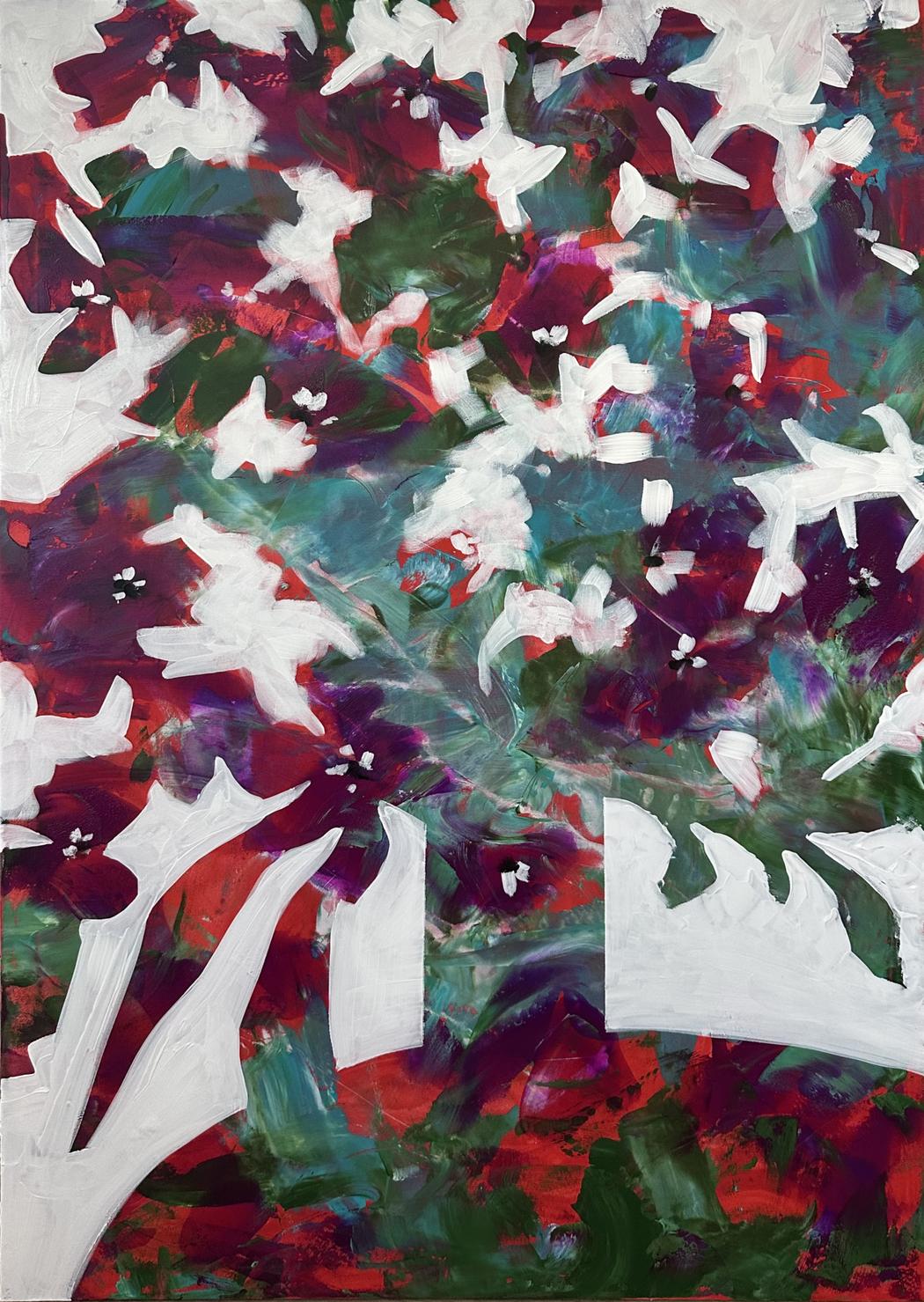 Darina Komorowski | White And Flowers | 2025
Leave a Reply
You must be logged in to post a comment.